



Rugs from Arak
Sarouk, Mahal, Lilihan and Ferahan from Markazi province
- Region
- Markazi province, central Iran
- Language
- Persian
- Knot
- mostly Turkish, partly Persian
- Material
- Wool on cotton
- Knots per m²
- 80,000 to 800,000 depending on type
- Well-known types
- Sarouk, Sarouk Mir, Mahal, Lilihan, Ferahan
Contents
An area with an export tradition
Arak lies in a fertile farming region, and the people speak Persian. The weaving area includes Sarouk, Ghiassabad, Jozan, Malayer, Mirabad, Mahal, Vis, Borjalu and Lilihan. In the mid 19th century, merchants from Tabriz began producing here for the West. Later, European firms followed, whose rugs are known today as Ziegler. To this day, makers work to preserve the good old traditions.
Sarouk and Ghiassabad
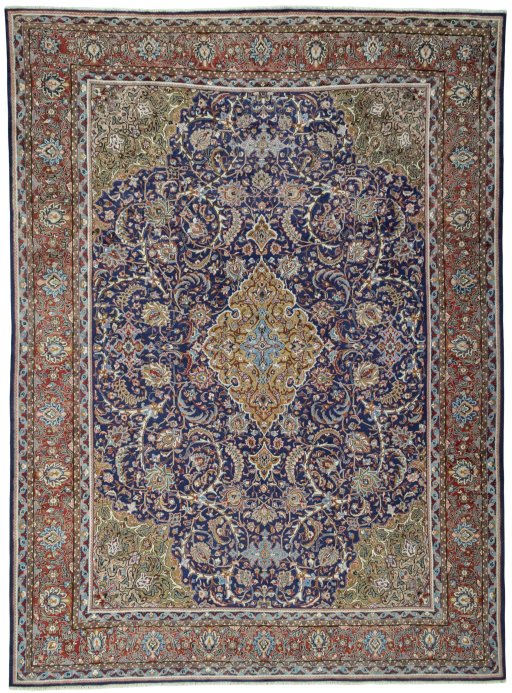
South of Malayer and Vis lies Sarouk. Rugs are woven here in workshops and at home. The wool often has a beautiful sheen, the knotting is compact and regular, and Sarouk rugs are among the longest-lasting in Iran. Typical is an elongated medallion with flowers or a Herati on a plain blue, red or beige ground, alongside allover floral patterns. The colours are wonderfully balanced, warm and muted or in strong red and blue. Knot density ranges from 150,000 to 600,000 knots per m². A speciality are the “American” Sarouks of the 1920s, with free-flowing sprays of flowers on a red ground.
Almost identical, but often even finer, are the rugs from Ghiassabad, with small bouquets of flowers on a beige, red, gold or blue ground and up to 800,000 knots per m².
Sarouk Mir
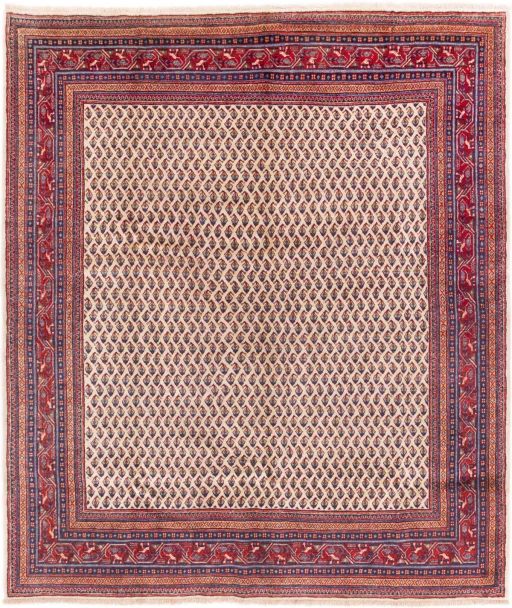
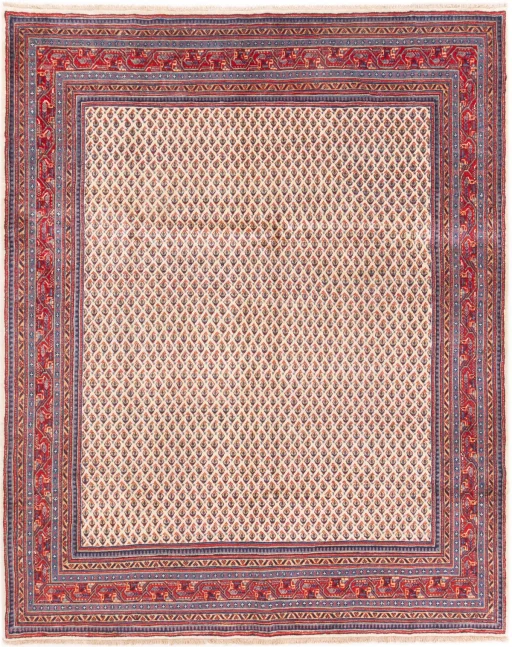
Sarouk Mir rugs are made in several places, especially around Mirabad. Typical is the Mir pattern, small botehs across the whole field, on a blue, red or beige ground with a Serabend border and several guard borders. Thanks to good wool, they are durable, affordable rugs.
Mahal and Lilihan
Mahal rugs from the area between Arak and Mahallat recall Sarouk, but are somewhat coarser and therefore more affordable. Thanks to good wool, they are very durable.
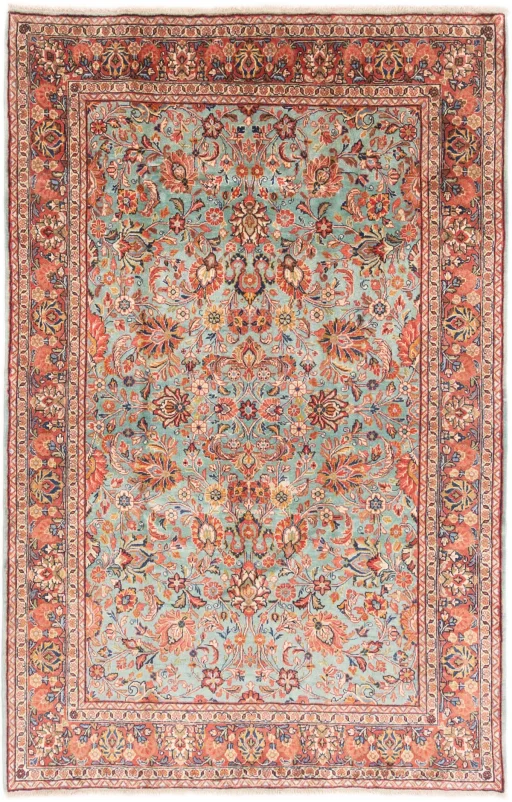
Around 80 kilometres southeast of Arak lies Lilihan, where mainly Armenian families weave. The rugs are easy to recognise by their large flowers on a red, blue or beige ground. Older pieces were knotted from especially fine wool with a silky sheen and are sought after by collectors.
Saveh, Vis and Tafresh
- Saveh in the north of the province, towards Tehran: strong colours with dark red and blue, geometric patterns and often very good wool. The rugs resemble Hamadan and are very durable for their knot density.
- Vis west of Arak: sturdy rugs with large geometric patterns in yellowish red, red and blue.
- Tafresh northeast of Arak: more finely knotted than most Hamadan rugs, with an unmistakable wavy medallion and rich contrasts.
Ferahan
The Ferahan valley west of Arak has a proud rug tradition. Very beautiful, densely knotted rugs of lustrous wool are made here. Typical is the Herati pattern, which is therefore also called the Ferahan pattern, across the whole field, with a Herati main border. Today weaving in the old tradition takes place mainly in Ibrahimabad. Well-preserved old Ferahan rugs are rare and valuable.
Ziegler: rugs for the West
The firm Ph. Ziegler & Co. of Manchester was the first known company to have rugs woven in Iran with foreign capital and exported. It was run by Philipp Ziegler. A photograph from around 1890 shows him with his wife Lilly, staff and companions in front of the company compound in Sultanabad. The firm originally traded in printed cotton fabrics from Europe for the Near and Middle East. After founding its first branch in Iran in 1867, it moved into the trade and manufacture of rugs and played a key role in the great rug boom of the late 19th century. In Europe and America, enthusiasm for new and antique oriental rugs was growing at the time, fuelled by the world's fairs and major museum exhibitions.
Why Sultanabad? At first Ziegler bought finished rugs on the market and exported them, new pieces as well as used ones from nomads. But because furnishing houses in the West wanted a reliable supply, the firm set up its own branch for production. The choice fell on Sultanabad, today's Arak: the city was the market of a large weaving area, lay on the route from Tehran to Baghdad, which Ziegler already used for its goods, and rugs from there were cheaper per square metre than comparable ones from other cities. Around 1877 Ziegler bought land for its own company compound.
Emil Alpiger. The first manager of the branch was Emil Alpiger (1841–1905). Between 1857 and 1896 he collected account books, a diary full of orders and dozens of pattern drawings. This collection is still the only known source that shows exactly how the Ziegler rugs were made and what they looked like.
How the work was done. Ziegler built on the cottage industry of the villages. Local agents, the amil, received dyed wool, pattern drawings and advances under contract, distributed them to the weavers and supervised the work. The finished rugs came to the company compound, where they were checked carefully against the order and packed for export. There were different quality lines. By 1894 Ziegler already had rugs woven in around 111 villages around Sultanabad.
From graph paper to rug
The patterns came partly from Ziegler itself and partly from the furnishing houses in the West that placed the orders. In-house pattern designers drew the rugs and painted them in watercolour or gouache on graph paper, with each square corresponding to one knot. Often a quarter of the rug was enough, and mirroring produced the rest. Weaving was done directly from this template or from a wagireh, a small knotted sample piece.
The surviving templates mainly show medallions with corner pieces on a calm, plain ground, a style that was very popular in the West at the time. There are also scrolling patterns, lattices and even pictorial motifs, such as a seated woman with a water pipe. The borders feature flowers, S-scrolls, sickle leaves and palmettes. Powerful allover patterns of large, stylised palmettes and leafy tendrils, inspired by the antique rugs that Ziegler also traded in, are now regarded as especially typical of Ziegler. They can be compared with the Orientalist painting of the time: both took up motifs of the Orient and gave them a form that suited European taste.
Herati and boteh. Alongside these, the traditional patterns of the area continued, the Herati from Ferahan and the boteh from Serabend. The weavers knew them so well that they needed no templates for them. A single order of 17 April 1878 for the London furnishing house Maple & Company, written “Mapple” in the diary, comprised 133 rugs, 67 of them with the Herati pattern. A report of the time praises the Ferahan rugs as ideal for drawing rooms, with soft, rich, deep colours, a fine, dense pile and often a deep blue ground full of small patterns in red, yellow, white and green. The Serabend rugs, it says, were made in a similar way, always with a plain ground in white, red, blue or yellow and a boteh pattern across the whole surface.
Competition and early pattern protection. Success soon attracted others. By the end of the 1880s, the European Persian Carpet Manufacturing Company was also working in Sultanabad, along with several Iranian entrepreneurs. Good designs were in demand, so they were protected even then: in 1881/82 a court decree forbade Iranian merchants to use European patterns and colours, and in 1891 the British diplomat S. T. A. Churchill brokered an agreement under which the European firms' designs were protected for five years.
Today the name Ziegler is a mark of quality in the trade for a whole style of generous, decorative rugs from the late 19th century. They bear no signatures or company marks, which makes Alpiger's templates all the more valuable for their history.
A Ziegler at Sigmund Freud’s home
Ziegler rugs were widespread in Europe and America. In Central Europe, where Persian rugs had long been appreciated, they were among the most precious furnishings of a home. One of them belonged to Sigmund Freud (1856–1939) in his flat in Vienna, a Ziegler Mahal from around 1880 measuring 5.03 × 3.71 metres with a large floral medallion and corner pieces on a light ground. When Freud emigrated to London in 1938, he took his entire collection with him. In his house in Hampstead, 20 Maresfield Gardens, the rug lay in the dining room, even after his death in 1939. In 1986 the house became a museum about his life and work.
Interestingly, Herati and Boteh designs were less in demand in the West at the time, so the Ziegler workshops used them less often. Many Ziegler rugs combine beautiful medallions and corner pieces with a calm ground or show light, finely graded allover designs.
Sarouk and Lilihan rugs from our shop
Frequently asked questions
What is a Sarouk?
A rug from Sarouk near Arak, known for lustrous wool, compact knotting and great durability, often with an elongated floral medallion on a plain ground.
What do Ziegler rugs have to do with Arak?
Arak used to be called Sultanabad. In the 19th century, European firms had rugs woven here for export, which are known today as Ziegler.
How do you recognise a Ziegler rug?
Typical are generous medallions with corner pieces on a calm, plain ground, or powerful allover designs of large palmettes and leafy vines, in soft, harmonious colours. They bear no signatures or company marks.
← Back to overview: Persian rugs from Iran
Sources
- Martin Munkholm: Oriental Carpets. Woven with passion. muusmann forlag, S. 116–121.
- Annette Ittig: Ziegler’s Carpet Cartoons. In: HALI 80, April/May 1995, pp. 82–87.
- Sotheby’s New York: auction catalogue “Carpets”, 11 June 2008.
- Own experience from the Akhavan Farshchi family's rug trade.
Co-Owner of Rugbloom. His family has traded Persian rugs for four generations. He recognises regions, eras and techniques and reads Persian inscriptions.