



Heriz rugs
Origin, patterns, qualities and how to recognise them
Heriz rugs are among the most robust rugs of Persia. They are made in Heriz and the surrounding villages in the highlands of East Azerbaijan, about 70 kilometres east of Tabriz. Their hallmark is the large, angular medallion, usually on a red ground.
Heriz at a glance
Contents
2. Landscape, sheep and wool
3. How to recognise a Heriz
4. Material and quality
5. The colours of a Heriz
6. History
7. From the village to America
8. Serapi and Bakhshayesh
9. Runners and the village living room
10. Heriz compared
11. Heriz in your home
12. Heriz rugs at Rugbloom
13. Frequently asked questions
Origin and people
The Heriz area lies in the highlands of East Azerbaijan, in northwest Iran. The people here are Azerbaijanis and speak Azerbaijani. Weaving has been part of family life for generations: often several women of one family work together at a large loom in the house. In older specialist literature, the place also appears under the name Iris.
Heriz is not a single village but a whole weaving area. Several places have their own names in the trade, which still stand for particular styles today:
- Ahar: knotted like Heriz, but with a more oval medallion and details drawn closer to nature. Ahar rugs were long considered the best of the area.
- Bakhshayesh: mostly large rugs in lustrous wool, with Boteh patterns as well as medallions.
- Gorovan: stands in the trade for a particularly strict, geometric design.
- Mehravan: another weaving place in the area with its own style.
In the 18th and 19th centuries, some exceptionally fine silk rugs were also made in Heriz and the surrounding area. They are very rare and sought after by collectors. Today, some families consciously keep the old tradition alive, with hand-spun wool and natural dyes. We present smaller neighbouring places such as Karaja and Lambaran on a separate page.
Landscape, sheep and wool
The actual weaving area is a triangle of around fifty villages southwest of the Sabalan massif, between Bostanabad, Ahar and Sarab. The largest places include Sarab, Ahar, Mehravan, Bakhshayesh and Heriz. The area lies at around 1,500 metres, the wind blows almost constantly from the mountains, and the winters are cold and snowy. Sabalan and Sahand are volcanoes, and their ash makes the soil especially fertile.
Herds of fat-tailed sheep in many natural colours graze on the high pastures, from beige and brown to black and creamy white. A lot of wool also came from the Shahsavan nomads, who move with their herds to the Sabalan and into the Karadagh in summer. Their wool is strong and lustrous, and when well sorted it is among the most durable and beautiful rug wools in Iran.
How to recognise a Heriz
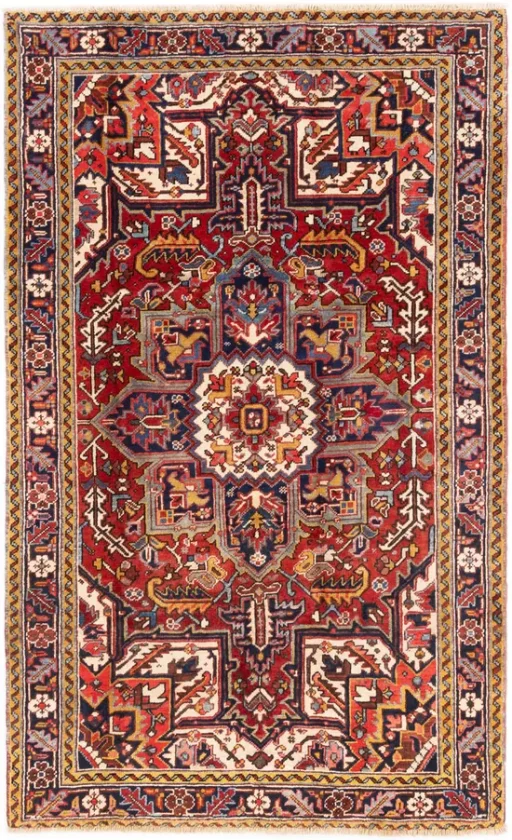
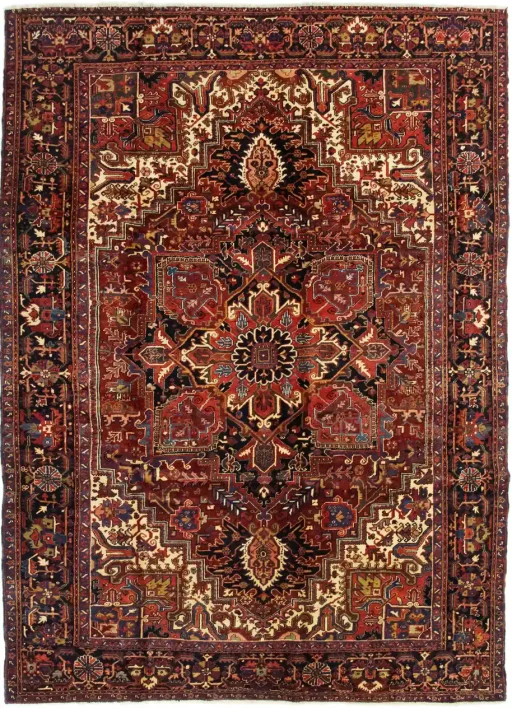
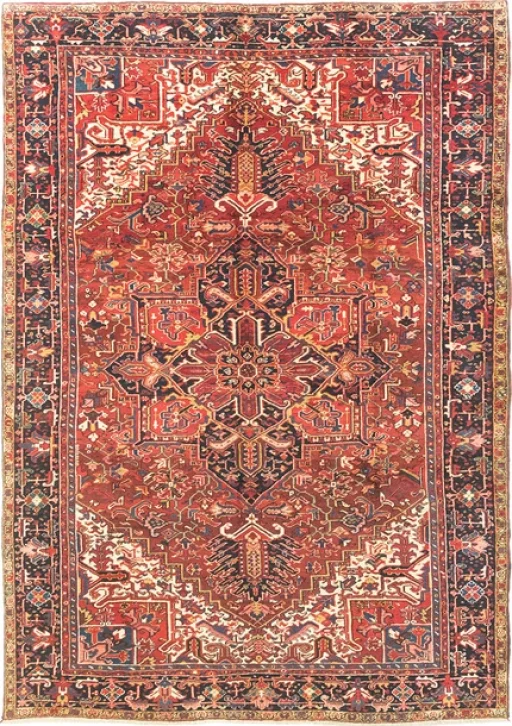
- Medallion: large, angular and with geometrically drawn floral filling, often with pendants along the long axis.
- Corner pieces: large and often light. They frame the medallion and look like sections of a larger pattern.
- Ground colour: mostly red, less often blue or ivory.
- Border: often the so-called turtle border or an angular vine with palmettes.
- Handle: dry, firm and heavy. A Heriz lies flat and solid on the floor.
- Small variations: the rugs are often woven from memory. Slight irregularities are a sign of handwork.
Material and quality
Heriz rugs are knotted from strong virgin wool on a sturdy cotton warp. The angular pattern suits this construction perfectly: the weave is coarse to medium fine, but very densely beaten and with a rather high pile. A typical 20th century Heriz has around 900 to 1,000 knots per square decimetre, or about 90,000 to 100,000 knots per square metre. Older pieces are sometimes finer.
There are also quality grades within the area. The finest, with particularly soft wool, is known in the trade as “Pashmi-e-Mashad”, meaning “wool from Mashhad”. According to the specialist literature, however, this wool does not come from Mashhad but from Maku in the far northwest of Iran, whose sheep are known for more lustrous wool. Silk Heriz rugs are very rare and sought after: they are exceptionally finely knotted, and their medallion is usually drawn more rounded.
It is said that the copper-rich water of the area strengthens the wool. Legend or not, a well made Heriz lasts for many decades under normal use. Its value depends above all on age, condition, the quality of the colours and the care taken in the knotting.
The colours of a Heriz
Almost every Heriz has at least three shades of red from madder, ranging from delicate pink through cinnamon and orange to dark purple. A medium shade was usually chosen for the field, and a rosé for about one rug in ten. The beauty of a Heriz often lies precisely in the harmonious interplay of these three reds.
Added to these are two or three shades of blue from indigo, a yellow probably from yellow larkspur (isparuk), a green made by overdyeing blue with yellow, and a light yellow green. Undyed grey wool for small motifs, natural white wool and dark, brown-dyed wool for the outlines complete the palette. A naturally dyed Heriz rarely has more than eleven colours.
Often a single dyer dyed the wool for an entire village. That is why the same colours appear again and again in rugs with a similar design. Water and soil, the mordant and the time in the dye bath create subtle differences in the red and the yellow.
History
Northwest Iran is one of the oldest rug landscapes in the country. In the 16th century, Tabriz was the residence of the Safavids, and large court carpets were made in the region. Alongside them there was a group of northwest Persian carpets without silk and without figural motifs, with massive medallions and angular arabesques. The rug scholar Reinhard G. Hubel explicitly describes this drawing as “like later in Heriz”. The angular Heriz style therefore has roots that go back a long way.
In the 19th century, Tabriz became the great trading and export centre for rugs to Europe and America. The Heriz rugs also reached the West via Tabriz. The Serapi rugs, so sought after today with their light, spacious design, date from this period. While many other regions adapted their patterns to the changing taste of the export markets, Heriz remained largely true to its geometric style, with only slight variations. That is exactly what still makes it so unmistakable today.
From the village to America
Systematic weaving for the West only began in the Heriz area at the end of the 19th century, above all for the USA. Contacts ran almost exclusively through Tabriz. At first the rugs were known in the trade under names such as Gorovan; only later did the name of the larger weaving town of Heriz become established.
Tabriz merchants supplied design drawings and sometimes small sample pieces, provided looms and pre-dyed wool, and employed master weavers to direct the work. There were also independent weavers who had their wool dyed in the village and sold their rugs in the bazaar or directly to the dealers in Tabriz. Both routes still exist today.
The first export Heriz rugs were modelled on a late 19th century Sarough medallion design, with a dark blue medallion, pendants, light corner pieces and a red main border. What was new was the turtle border, which developed from the classic cloud bands and palmettes. Instead of the region's long, narrow formats, weavers made sizes of about 3 × 4 to 4 × 6 metres, suited to American living rooms, on large vertical looms in the living rooms of their houses. How early these rugs were already arriving in America is shown by a Heriz given to a doctor in Michigan as a wedding present in 1902.
The 1920s were the heyday of the Heriz. Demand from America and Europe was high, and the villages still dyed with natural dyes. Six to eight women could knot a 3 × 4 metre medallion rug in a few weeks. Very large rugs of up to about 5 × 10 metres were also made, many of them for private clubs, along with new allover patterns with palmettes and rosettes and, very rarely, rugs with animals, people and birds from Persian legend. Typical of this period are the yellow-ground main border and rosettes whose centres look speckled thanks to two-coloured plied yarn.
Like the Ushak rugs of the 16th century and the Transylvanian rugs of the 17th century, the Heriz was made for a large market, and like them it has long since become a distinctive, beautiful classic in its own right.
Serapi and Bakhshayesh
In the trade, the early Heriz rugs are called Serapi, a name that stands for high quality. It comes from the town of Sarab on the southern side of the Sabalan, where large rugs were also made for export. Typical of the first generation are a generous scale and calm, open areas in the field. The red field often floats freely without touching the borders. A bold, eight-lobed medallion in dark blue, probably designed in a Tabriz design studio, carries pendants in light and dark blue, yellow, green and pink. The corner pieces are ivory, yellow or light blue and show a quarter of the medallion. The medallion style itself goes back to the Safavid era.
Bakhshayesh has long been regarded as a place of particularly good rugs. Many Bakhshayesh rugs are camel coloured and show an archaic looking medallion, sometimes with animal-like forms, in camel, light blue, pink and yellow. Even older are long 19th century rugs made for the weavers' own use, such as an ivory-ground rug measuring 5.75 × 3.25 metres dated 1222 of the Hijra, that is 1807, with an allover pattern of small floral medallions.
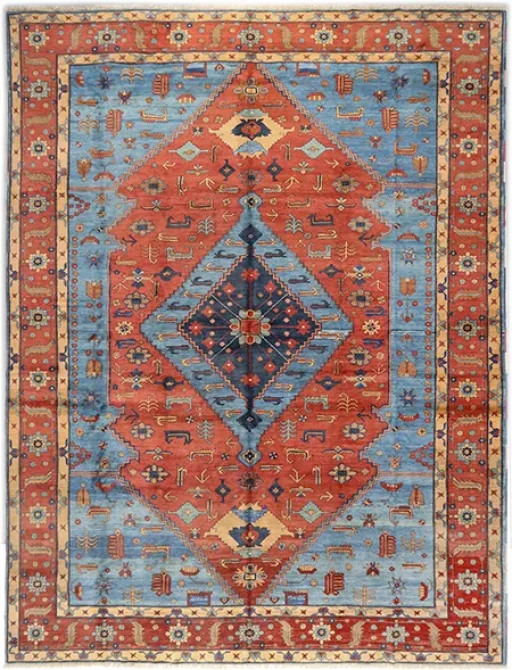
There were also very finely knotted special commissions with delicate arabesques or tree patterns, often with a blue field, which were probably made in workshops in Tabriz.
Runners and the village living room
In a typical Azerbaijani village house, three kenareh, that is long runners, lie in the living room, together with flatweaves such as gelim and jajim, which are also found in mosques. The large keley format, otherwise widespread in Iran, is hardly found in the Heriz area because it does not fit the narrow living rooms. Runners were knotted above all in Karaja and Sarab, and the kenareh for many other villages also came from there. Small Heriz rugs are rarer than large ones. Some recall Kazak rugs or take up Caucasian patterns, such as the Karabagh designs with an eagle or sun.
Heriz compared
Heriz, Tabriz and Bijar all come from northwest Iran, but they differ clearly:
| Heriz | Tabriz | Bijar | |
|---|---|---|---|
| Pattern | Angular, geometric medallion | Very varied, mostly floral | Herati, medallions, often very dense |
| Weave | Coarse to medium fine, very dense | Medium fine to very fine | Medium fine to fine |
| Handle | Firm and heavy | Depends on quality | Stiff as a board, extremely heavy |
| Special feature | Large sizes, clear design | Fast weavers, their own knotting hook | Very thick filler weft |
| Ideal for | Living and dining rooms | Classic, elegant rooms | Rooms with the heaviest wear |
Heriz in your home
A Heriz brings warmth and structure to a room. Its clear, geometric design suits classic furniture as well as modern, minimalist and industrial interiors. Thanks to its robustness, it is also suitable for dining rooms and hallways. Because Heriz rugs were often woven in large sizes, you can also find the right piece for large living spaces.
Heriz rugs at Rugbloom
Available now, straight from our stock:
Frequently asked questions
Is a Heriz rug hand-knotted?
Yes. Every Heriz is knotted by hand on a loom, knot by knot, with the symmetrical (Turkish) knot. A large rug means many months of work.
How do you recognise a Heriz?
By the large, angular medallion with geometrically drawn floral filling, the large corner pieces, the mostly red ground and the firm, heavy handle. The foundation is cotton and the pile is strong virgin wool.
What is a Serapi?
Serapi is a trade name for older, particularly beautiful rugs from the Heriz area, mostly from the late 19th century. They often have lighter colours and a more spacious design and are highly sought after by collectors. The name comes from the town of Sarab in the Heriz area.
Are there silk Heriz rugs?
Yes, but they are rare. Silk Heriz rugs are very finely knotted, and their medallions are usually drawn more rounded than on the well-known wool Heriz.
What do Gorovan, Ahar and Bakhshayesh mean?
These are places in the Heriz area whose names stand for particular styles and qualities in the trade. Gorovan was one of the first trade names for Heriz rugs, Ahar rugs show a more oval medallion drawn closer to nature, and Bakhshayesh is known for large rugs in lustrous wool.
What is a Heriz best suited for?
For heavily used rooms such as living rooms, dining rooms and hallways. Thanks to the dense weave and the robust wool, a Heriz lasts for many decades. Its clear, geometric pattern also suits modern interiors.
How do you care for a Heriz?
Vacuum it regularly, ideally without a rotating brush, and turn the rug from time to time so that it fades evenly. Dab stains immediately with clear water, do not rub.
Why is the pattern not perfectly symmetrical?
Many Heriz weavers work from memory without a design to follow. Small variations are therefore a sign of handwork and part of the rug's character.
When was the heyday of Heriz rugs?
In the 1920s. Demand from America and Europe was high, and the villages still dyed with natural dyes. Many large medallion rugs with a yellow-ground border date from this period.
How many colours does a Heriz have?
A naturally dyed Heriz rarely has more than eleven colours. Typical are three shades of red from madder, two or three shades of blue from indigo, plus yellow, green and natural white.
Sources
- Reinhard G. Hubel: Ullstein Teppichbuch. Eine Teppichkunde für Käufer und Sammler. Frankfurt am Main: Ullstein 1972, pp. 166, 174–176.
- Raoul E. Tschebull: Heriz. A Historical Perspective. In: HALI 90, January 1997, pp. 64–73.
- Our own experience from the Akhavan Farshchi family's rug trade.
Co-Owner of Rugbloom. His family has traded Persian rugs for four generations. He recognises regions, eras and techniques and reads Persian inscriptions.