



Kashan rugs
Fine city rugs from the edge of the great salt desert
- Region
- Isfahan province, central Iran
- Knot
- persisch
- Material
- good wool on cotton, flowers sometimes in pure silk
- Knots per m²
- etwa 250.000 bis 800.000
- Pattern
- Medallion with corner pieces, column Kashan, mirror Kashan, hunting and pictorial rugs
- Ground colours
- Red, blue, beige
Contents
A golden age
Under the Safavids (1502 to 1722), Kashan was one of the great centres of rug art. Natural silk is said to have been used in rugs here for the first time, as famous pieces of the period show, such as the Ardabil Carpet in London, whose inscription names a master from Kashan, and the hunting carpet in Vienna. Find out more on our page History of the oriental rug.
With the Afghan invasion of 1722, production came to a standstill and only revived at the end of the 19th century. The famous rugs of the master Mohtesham date from this time. For around 30 years his workshop produced pieces that are found today as Kashan Mohtesham in museums and private collections all over the world and are among the most coveted collector's rugs.
The small silk rugs of the 16th century
Among the most precious carpets of the Safavid period is a small group of 16th-century silk rugs attributed to Kashan. Sixteen pieces are known today, all only about 1.7 × 2.5 metres in size. They were recognised as a coherent group in 1916, when five were known. The Metropolitan Museum of Art in New York owns four of them; three were bequeathed to it in 1914 by the merchant and collector Benjamin Altman, together with his large collection of Chinese ceramics, European paintings and Persian and Indian carpets. From August 1994 to January 1995 the four were exhibited together for the first time.
Animals, trees and medallions. The rugs show two kinds of design. On some, animals move in rows across the field, with animal combats between flowering trees that grow from small rocks, almost like a landscape. The others bear a large medallion with four or eight lobes, scrolling vines, palmettes and cloud bands after Chinese models. The field is almost always red; only one piece, in the Louvre, has a blue ground. Added to this are blue, dark green, yellow and beige, sometimes salmon pink and silver brocading on white silk.
Entirely of silk. Warp and weft are of natural silk, as is the pile, knotted with the asymmetrical (Persian) knot at 7,500 to almost 9,300 knots per dm². The workshop worked with a stock of designs that were freely combined: the same medallion appears with different field patterns, the same row of animals in several rugs. The small silk rugs are closely related to the three large silk hunting carpets in Vienna, Boston and Stockholm. Borders, animal pairs and medallions are so alike that all were probably made in the same workshop, over sixty or seventy years from around 1530 or 1540. The Vienna hunting carpet is considered the most beautiful.
The age of Shah Tahmasp. The rugs belong to the golden age of court art under Shah Tahmasp, when, between around 1525 and 1543, his famous Shahnameh, Nezami’s Khamseh and the Ardabil carpets were also created. The only surviving Persian wall paintings of the 16th century, hunting and landscape scenes in a small palace in Nain from around 1560, resemble the Kashan rugs in style and theme.
Carpets for a Polish king. Before and after 1600, Kashan was a major centre of the silk trade and silk weaving, and travellers repeatedly praised the city for its fine carpets. In the early 17th century Shah Abbas founded a royal carpet workshop here. In 1601 the Polish king Sigismund III Vasa ordered several carpets in Kashan, which were delivered in 1602. The invoice even includes a surcharge for weaving in the royal coat of arms. Two silk tapestry-woven rugs with the Vasa arms survive. A carpet in the Munich Residenz probably came to the Wittelsbachs in 1642 as the dowry of a Polish princess.
Pattern
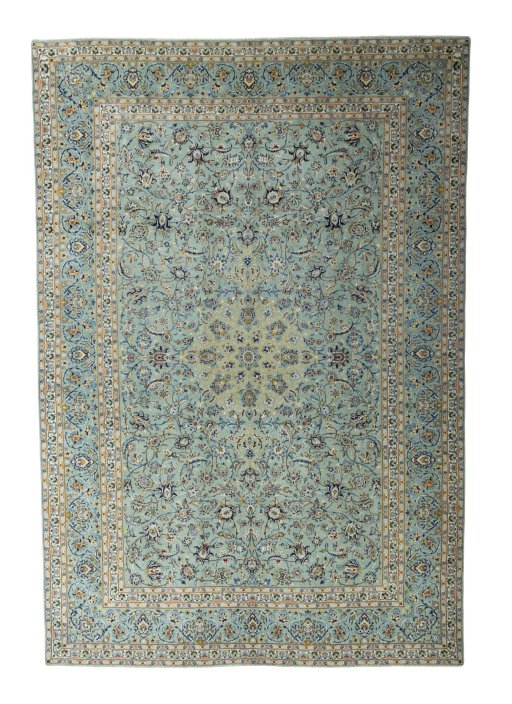
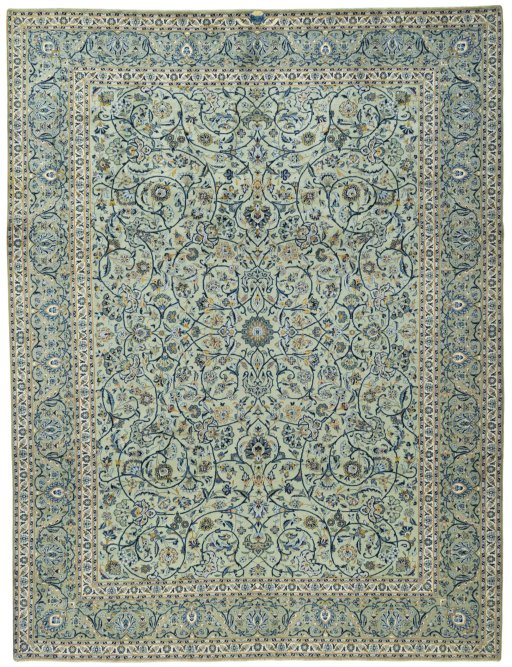
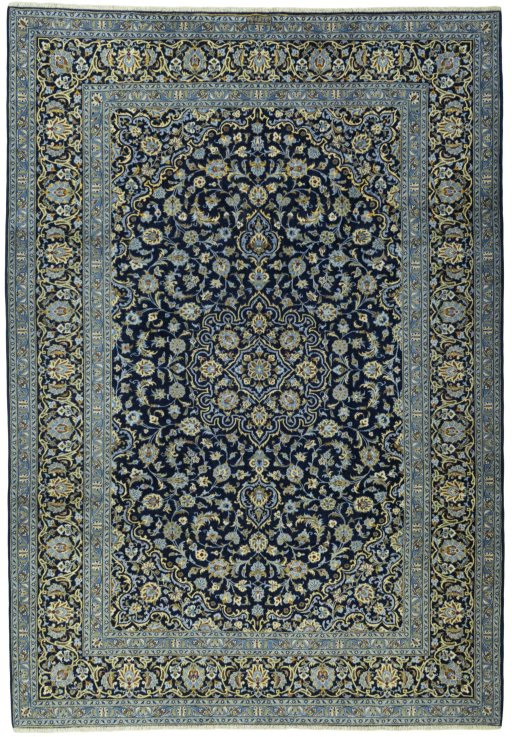
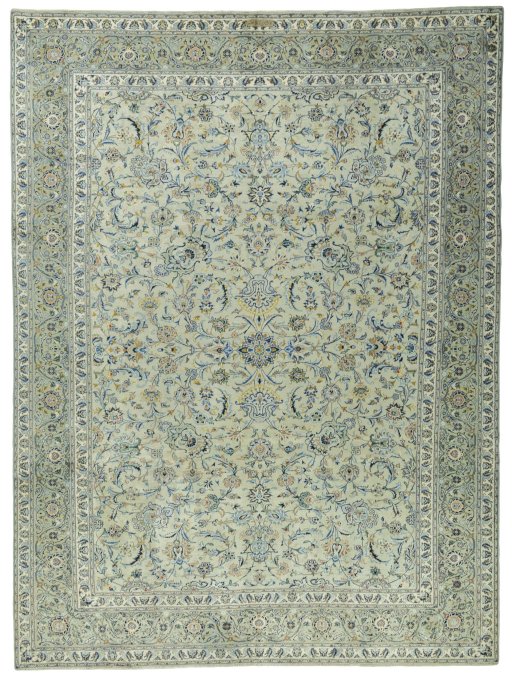
The most common pattern is a central medallion with corner pieces on a blue, red or beige ground, the field densely filled with leafy tendrils and flowers. There are also special types:
- Column Kashan: a prayer niche with vases full of flowers or the image of a mosque or a Persian house.
- Mirror Kashan: a central medallion with pendants on a plain ground, usually red or blue.
- Pictorial rugs: historical motifs such as a shah on the hunt, especially in old Kashan rugs.
Many Kashan rugs are signed by the weaver or the pattern designer, or with the name of the workshop. Sometimes individual motifs, such as all the flowers, are knotted in pure silk. Kashan rugs knotted entirely of silk are still made today but rarely come onto the market.
Kashan today
Kashan continues to produce beautiful rugs that preserve the old patterns with great care and precision. They are woven with the Persian knot on cotton, the pile is good wool, with 250,000 to 800,000 knots per m².
Kashan rugs from our shop
Frequently asked questions
What is typical of a Kashan rug?
A central medallion with corner pieces on a red, blue or beige ground, the field densely filled with tendrils and flowers, finely knotted with the Persian knot.
What is a Kashan Mohtesham?
A rug from the workshop of the master Mohtesham, who worked in Kashan for around 30 years at the end of the 19th century. These rugs are sought-after collector's pieces.
What are the small Kashan silk rugs?
A group of sixteen small 16th-century silk rugs, about 1.7 × 2.5 metres in size, with rows of animals or medallions on a mostly red ground. They were probably made in the same workshop as the large silk hunting carpets in Vienna, Boston and Stockholm. The Metropolitan Museum of Art in New York owns four of them.
← Back to overview: Persian rugs from Iran
Sources
- Martin Munkholm: Oriental Carpets. Woven with passion. muusmann forlag, S. 125–127.
- Daniel Walker: Metropolitan Quartet. In: HALI 76, August/September 1994, pp. 104–107.
- Own experience from the Akhavan Farshchi family's rug trade.
Co-Owner of Rugbloom. His family has traded Persian rugs for four generations. He recognises regions, eras and techniques and reads Persian inscriptions.