



Nain rugs
The finest rugs from the desert town east of Isfahan, with Tudeshk
- Region
- Isfahan province, central Iran
- Knot
- persisch
- Material
- very finely spun wool with silk outlines, warp mostly cotton
- Knots per m²
- etwa 300.000 bis 1.000.000
- Pattern
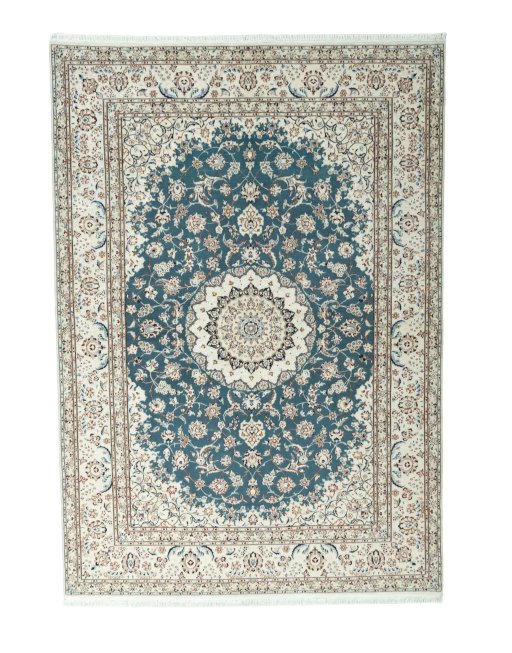
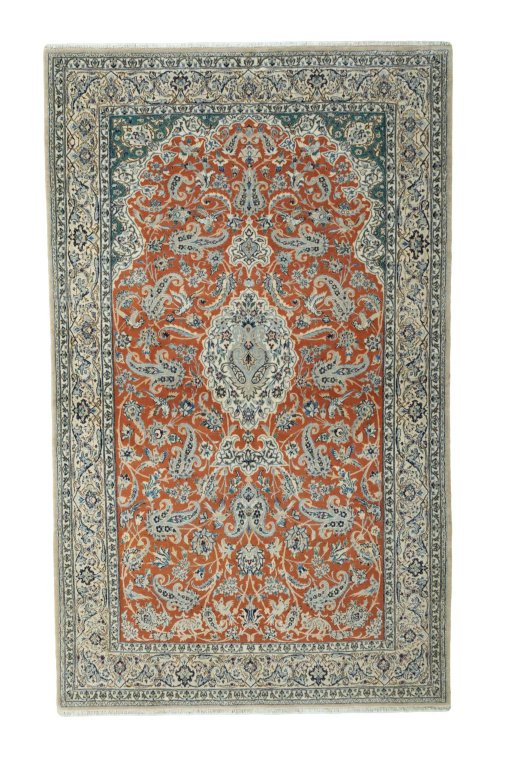
- Shah Abbasi medallion, birds and tendrils, mihrab
- Colours
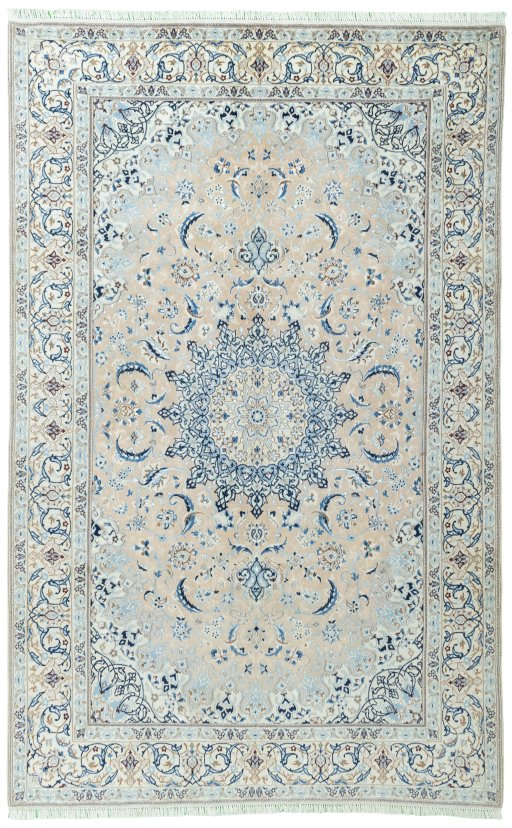
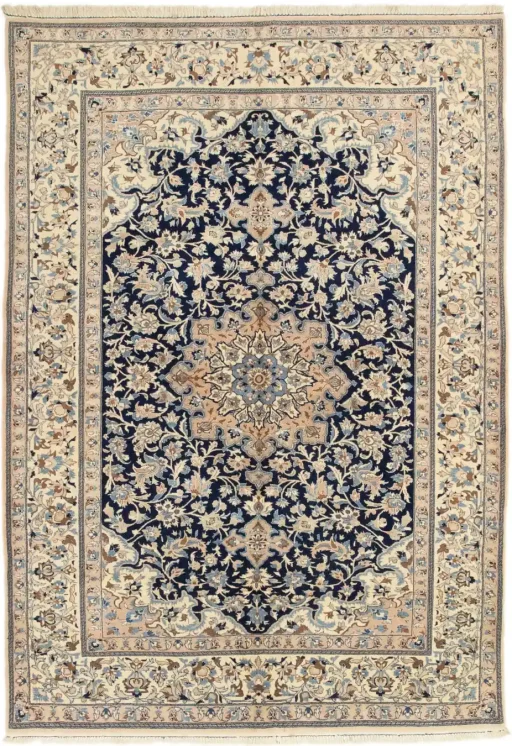
- Cream, blue, light blue, gold
Contents
From textiles to rugs
At the beginning of the 20th century the textile industry flourished in Nain. When it declined in the 1930s, it became the basis of the rug craft: the spinners could produce exceptionally fine yarn, and with it very dense rugs can be knotted. Within a few decades Nain became one of the best-known names in the rug world.
The town itself seems straight out of the Thousand and One Nights. Its Friday Mosque is one of the first mosques in Iran after the Arab conquest, and deep beneath the town lies an old underground watermill.
Patterns and colours
Nain rugs are harmonious and beautiful, often with birds and floral tendrils or a mihrab with mosaic patterns. The Shah Abbasi medallion is the most common. The colours are usually limited to light cream, blue, light blue and gold. Typical are fine silk outlines around the individual motifs, which make the pattern stand out like a highlight.
The qualities: 9la, 6la and 4la
In Nain, quality is distinguished by the number of threads from which the warp is spun: Nohla (9 threads), Sheshla (6 threads) and Chaharla (4 threads). The fewer the threads, the thinner the warp and the finer the knotting can be. A 4la Nain is therefore among the finest pieces. Within each grade there are again several qualities, so an expert's eye is always worthwhile.
Tudeshk and well-known signatures
Fine rugs have been made in Nain and nearby Tudeshk since the 20th century. One of the first great masters was Pahlavan Safai, whose rugs are much sought after by collectors. Among the finest Nain rugs are also the signed rugs of the Habibian family, who previously worked in textile production. Other well-known signatures are Draksesh, Khamesi, Youssoffi, Mohammadi, Ahmadi Akhavan and Ghorbani.
Nain rugs from our shop
Frequently asked questions
What do 9la, 6la and 4la mean for Nain rugs?
The number indicates how many threads the warp is spun from. Fewer threads mean a thinner warp and finer knotting, so a 4la Nain is among the finest qualities.
How do you recognise a Nain?
By light colours such as cream, blue and gold, by fine silk outlines around the motifs and often by the Shah Abbasi medallion.
← Back to overview: Persian rugs from Iran
Sources
- Martin Munkholm: Oriental Carpets. Woven with passion. muusmann forlag, S. 128–129.
- Own experience from the Akhavan Farshchi family's rug trade.
Co-Owner of Rugbloom. His family has traded Persian rugs for four generations. He recognises regions, eras and techniques and reads Persian inscriptions.