



Rugs from North Africa: Kairouan, Rabat, Beni Ouarain and Berber
North Africa at a glance
The art of knotting in the Maghreb
Knotting probably came to North Africa early with the Arabs, but there is no evidence for this. Among the Maghreb rugs, those from Kairouan in Tunisia became better known than those from Gabès and other towns because they are more finely knotted. The 19th century Kairouan rugs shown in the local museum look purely Turkish. Kula and Ghiordes patterns were reproduced almost faithfully by the partly Turkish weavers, because Tunisia was under Ottoman sovereignty until 1881.
Morocco
The most important manufactories in Morocco were in Marrakesh and Casablanca, later in Rabat and Fez. But their rugs never became as well known as Moroccan embroidery, leatherwork and gold and silver work. Before the First World War, France tried to revive rug production in Morocco. In their patterns, old Moroccan rugs are more reminiscent of the Mamluk carpets than of Anatolian ones, which is why some researchers long considered the Mamluk carpets to be Moroccan. The small-scale geometric patterns of older pieces are kept in plenty of strong red, blue and yellow.
Beni Ouarain: the white rugs of the Middle Atlas
Beni Ouarain rug: a net of fine black diamond lines on a cream ground, with small diamonds and crosses in some compartments. Our own simplified drawing.The Beni Ouarain are a confederation of seventeen Berber tribes. Their ancestors probably lived in the far northeast of the Middle Atlas as early as the 9th century. Some trace their origin to southern Tunisia, others to present-day Mauritania. They speak a Berber language called Ruafa or Thazighth. Their land stretches from the Djebel Bou Iblane mountains in the south to the Djebel Tazekka in the north, with houses of stone and clay in the valleys.
For a long time, part of every family moved with the herds up into the mountains in summer and down into the hill country in winter. On pastures up to about 1,800 metres, an old, small breed of sheep still lives today, and its excellent wool defines the quality of Beni Ouarain rugs. The weaving tradition is probably as old as the settlement itself, because warm textiles were needed in the cold highland winters.
A rug as a bed
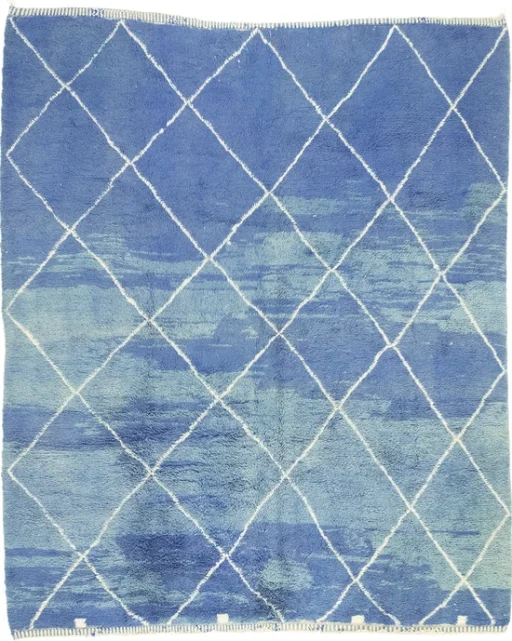
In the Berber language the rugs are called Tahlast, in the plural Tihlasine. Unlike most tribes in the Atlas, the Beni Ouarain did not use them as floor coverings but as beds and blankets. That is why they are loosely woven and mould themselves to the body, with a high pile that can be up to 7 cm long. Warp, weft and pile are of white wool, and the knot used is usually the Berber knot.
The classic pattern is a lattice of fine black lozenges on a white ground. This style of decoration is ancient: it appears in similar form on the rural pottery of the Maghreb and has probably changed little since the Neolithic. Borders are rare. Because the Beni Ouarain withdrew into the mountains of their own accord, their patterns remained untouched by the rugs of the cities until well into the 20th century. The oldest known pieces date from the second half of the 19th century. Alongside the strictly drawn rugs there were always richly patterned ones, which were considered especially precious. Their calm, clear design makes Beni Ouarain rugs favourites of modern interiors today.
The neighbours of the Beni Ouarain
Around the Beni Ouarain, related tribes wove rugs with their own signature. The Zerarda made silky, lustrous, almost pure white rugs of quiet elegance. The rugs of the Beni Alaham have strong, striped kilim ends. Among the Ait Youssi and Ait Serrouchène, yellow, orange and red are added, and the Ait Serrouchène fill the lozenge lattice densely with small motifs. Typical of the Ait Youb are concentric lozenges and zigzag lines with small “eyelashes” on both sides. Rugs with a black ground are very rare; they show that there were once more black sheep in the flocks.
The semi-nomadic Beni Jelidassen weave cushions that are opened up and used as rugs. On the back of finished flatweaves they paint crosses in henna as protective signs when the piece is taken off the loom. Crosses also appear on the inner walls of their houses. The women of the region also weave fine flatweaves, ceremonial cloths worn only on special occasions, and large bags.
Rabat: city rugs after Turkish models
Many of the early Moroccan rugs known today reached museums through collectors. The collection in the Musée National des Arts d’Afrique et d’Océanie in Paris, for example, comes from two pairs of collectors: Mademoiselle Anthoine, a nurse who bequeathed early pieces from the High Atlas in 1965, and Dr Lelong and the artist Thérèse Lemerle. The two met in Marrakech in 1927 and bought rugs directly from the caravans passing through the city, advised by Prosper Ricard, whose work Tapis Marocains (1927) is still regarded as the standard reference.
Rabat rugs were probably made from the early 19th century onwards in urban workshops for the houses of wealthy families. Their long, narrow format suits the typical Moroccan room. They are clearly inspired by Anatolian rugs such as Milas, Mudjur, Kula and Ladik, with a large yellow-ground central field and prayer niches. Their borders also show lozenges, chequerboard patterns and zigzag bands from Berber art. Typical of Rabat are rich colours and stars set within lozenges or octagons. A Rabat rug thus combines Turkish splendour and Moroccan geometry into something entirely its own, and it is precisely this blend that makes Rabat rugs the best known knotted work of Morocco.
Middle and High Atlas
In the Berber rugs of the Middle Atlas, function determines form. They are large enough to serve a whole family as a bed, with a high pile like a fleece. Most tribes, among them the Beni M’Guild and the Zaiane, descend from the Sanhadja. Their rugs show lozenges in many forms, often combined into large medallions, on red, orange or yellow with blue and purple. In the north-east, among the Beni Ouarain, Marmoucha and Ait Youssi, live tribes descended from the Zenata, who have been settled there for almost a thousand years. Their rugs have the highest pile of all Moroccan rugs and a great deal of white and black. Their firm Berber knot over three warp threads is a Moroccan peculiarity.
From the High Atlas, above all from Djebel Siroua, come rugs of especially silky, lustrous wool, because the dry climate near the desert produces a long-staple wool as silky as the finest wool of the Orient. Between the rows of knots lie many wefts, at least ten. Many pieces are made in a special mixed technique: knotted pile, slit kilim, plain weave and weft patterning alternate in bands. For all their simplicity, the best High Atlas rugs are finely balanced, with lozenges, zigzags and ladders in a free arrangement.
Berber rugs
Even in Hubel’s day, Berber rugs had become established in Europe. Their clear patterns suit the sturdy knotting and the high pile, often in natural wool colours, and they fit well into modern homes. North African production at the time was dominated by Persian patterns, geometric floral and tile patterns in ivory, light to blackish brown and grey.
Moroccan rugs from our shop
Frequently asked questions
What is a Kairouan rug?
A rug from Kairouan in Tunisia. The 19th century pieces follow Turkish models such as Kula and Ghiordes, because Tunisia was Ottoman until 1881.
What is a Berber rug?
A high-pile rug made by the Berber tribes of Morocco and North Africa, often in undyed natural wool colours and with geometric patterns. Many originally served as beds and blankets.
What is a Beni Ouarain rug?
A Berber rug of the Beni Ouarain, a confederation of seventeen tribes in the north-east of the Middle Atlas in Morocco. Typical features are cream-white wool, a high, soft pile and a lattice of fine black lozenges. These rugs originally served as beds and blankets.
What is a Rabat rug?
A Moroccan city rug, probably knotted in workshops in Rabat since the early 19th century. It combines Anatolian models with the lozenges and zigzag bands of Berber art, in a long, narrow format and rich colours.
Other countries
Sources
- Reinhard G. Hubel: Ullstein Teppichbuch. Eine Teppichkunde für Käufer und Sammler. Frankfurt am Main: Ullstein 1972, pp. 310, 313.
- Article on the rugs of the Beni Ouarain. In: HALI 94, September 1997, pp. 68–74.
- Gérard Boëly and Marie-France Vivier: From Rabat to the Atlas. Moroccan Carpets in the MAAO, Paris. In: HALI 94, September 1997, pp. 75–79.
- Our own experience from the Akhavan Farshchi family's rug trade.
Co-Owner of Rugbloom. His family has traded in oriental rugs for four generations.